



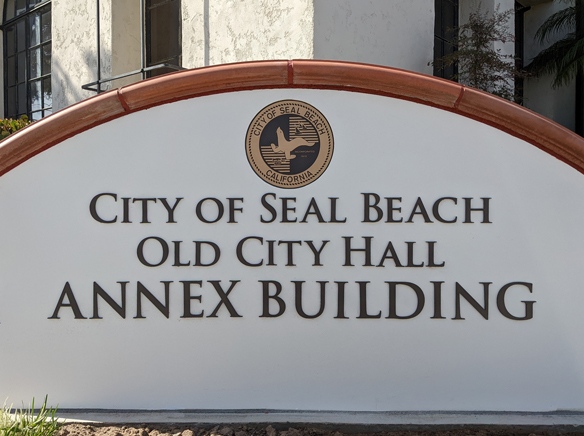
Several residents raised concerns about the Seal Beach’s finances during the July 28 council meeting.
During the public comment part of the meeting, four individuals objected to proposed increases to water and sewer rates. No one spoke in favor of the rate increases.
City officials and the consultant have argued that the rates need to be increased to maintain infrastructure and to service debt. The numbers they provided varied.
One individual was concerned about money spent on a parking consultant without action from the council.
None of the council members responded to the comments.
The Brown Act allows officials to “briefly respond” but the text does not described the length of a “brief” comment.
The debt concerns
The water and sewer rate hearing is scheduled to continue on Monday, Aug. 11.
Readers may recall that water and sewer rates went before the council last year, but the rate hearing was closed at that time without any action in apparent response to public opposition.
No one filled out speaker cards. Seal Beach does not require the public to fill out speaker cards.
The following is not a transcript but rather highlights from the meeting.
One man said the proposed debt would come to $100 million over 30 years. He expressed concern about the cost of interest payments alone.
James Jansen said a lot of the people who speak to the council represent a lot of their neighbors. He said not a lot of people have the appetite to speak at the microphone. “Some of them might be worried that we’d be called names in the press like angry voters,” Jensen said.
He quoted a document as saying that that credit agencies care about whether a city will slash budgets, raise taxes, cut services, or raise fees.
“Now we don’t slash budgets so we can take that off the list right there,” he said. “Our idea of belt tightening is to get bigger pants and a bigger shirt to let things out. We do raise taxes, so we’ve got a couple of points here,” he said.
“Some cities do small things like close the library a little bit early or do stuff like that,” he said.
“What we did several years ago was basically send half of the sewer responsibility of the city to the citizens,” he said.
He said the city did that by making the sewer line itself only the responsibility of the city and the connections and laterals the responsibility of residents.
He said the connections are the problem.
“Particularly in California, those connections are bad because we’ve had decades of seismic activity, which rustles those things around,” Jensen said.
“All raising the fees to the citizens does is prove to the people we want to borrow money from that and we will do whatever it takes,” he said.”
He said that according to the financial articles he read online, the most unsuccessful cities were those that failed due to overleveraging. “And the primary way they overleverage is to have aggressive infrastructure plans completely funded by these loans,” he said.
“What they call debt servicing is kind of a euphemism,” he said. “We owe money.”
He said, three, four, or five years from now the city would need another loan.
Ellery Deaton, a former council member, said she sat at the same dais in 2014 with the same issue before her. (Deaton retired from office in 2019.)
Deaton said three difficult points had not been addressed.
“The first one is billing,” she said.
“The second one is the number of projects,” Deaton said.
She said the third was loans.
“The billing methods need to be changed to be actually equitable and not just legally defensible,” she said.
“Prop. 218 is supposed to make billing equitable, but instead of true equity, all we talk about is legally defensible,” she said.
“These are two entirely different concepts,” Deaton said.
“Equity means we will all pay the same according to the service we receive,” she said
“Legally defensible is what the attorney decides we can get away with and call equity,” she said.
“Projects. There are too many projects that we are trying to do in too short a period of time,” she said.
“There are too many for our staff to complete and too many for the investors or ratepayers to be able to afford,” Deaton said.
She said if staff was unable to complete projects while increasing rates year over year, then the public would have no confidence they can do so now by charging the public more.
(Editor’s note: The previous water and sewer rate was approved in February 2021, when the council reduced wastewater revenue in Fiscal year 2021 by 25%, according to the Water and Wastewater Rate Study Final Report of Jan. 4, 2021. The only remaining council member from that time is District One Councilman Joe Kalmick, who cast one of the four votes in favor of that rate study.)
She said the city would borrow $52,950,000 at 2.5% over 30 years, 4% over 20 years and an estimated 5% over 30 years. She used her hands to make quotation marks in the air as she said “estimated”. “Has anybody done the math?” Deaton asked.
“That means saddling our tiny population with over $119 million in principal and interest for 20 to 30 years,” Deaton said.
“That is for at least two generations,” she said.
“We won’t have any new technology that we need to add in that period of time, that 20 to 30 years?” she asked.
“By the way, according to our annual budget passed just last month, we already owe $3,079,956 in current enterprise fund loans,” she said.
Deaton said this was not sustainable.
She called for a new cost of service study and called on the council to direct the consultant to factor in a flat fee for every door that receives water and sewer to create equity. “By the way, consultants deliver the results that they are asked to bring back,” Deaton said.
She said the options are not acceptable because they don’t address the systemic problems.
She said there was too much money going out of the General Fund to salaries and too much leverage for a small town to pay back, and a lack of a track record for completing projects.
Teresa Miller called for transparency from the city. “Transparency means more than just open meetings and documents posted online. It means clear, honest communication about decisions, priorities, and finances,” she said.
“Right now, we’re facing a serious financial reality, a structural deficit,” She said.
According to Miller, without change the structural deficit would push Seal Beach toward bankruptcy.
“Every dollar must count. Every dollar must be clearly tracked, and every spending decision be justifiable to the people who earned the dollar and entrusted it to the city,” Miller said.
“We have all felt the inflation in our daily lives this year, especially with gas and insurance, medical bills, utilities, all skyrocketing,” Miller said.
“This context makes it all the more critical for city leadership to make the responsible choices for the city of Seal Beach,” Miller said.
She called on the council to pause projects that she said were not urgent such as revitalization plans and building improvements that are not necessary.
“Cut things that we no longer can afford,” she said.
“Maybe the downtown visioning plan that was looked at earlier this year. Freeze hiring right now, explore outsourcing of city services and evaluate a compensation freeze or reduction and revisit and revise the FY26 budget to reduce spending across all departments,” Miller said.
“These kinds of fiscally disciplined decisions were expected during the initial budgeting process. They didn’t happen then, but you have another opportunity to do it now,” Miller said.
Miller said it was unacceptable for residents to bear a massive debt burden for decades while staff receives high compensation and perks funded by taxes.
“I believe that residents, staff, and council all want the same thing, a safe, vibrant, economically stable city,” Miller said.
“In the end, remember whose money is it?” Miller asked.
“It is not the city’s money,” Miller said. “It’s the community’s money that is held in trust for you to do the right thing on behalf of the city,” Miller said.
Parking concerns
Rick Mansour, a 30-year resident, raised concerns about what he described as stalled action on potential metered parking for Main Street.
He was also concerned about money spent on consultants. (The Ad Hoc Parking Committee in February 2024 recommended against paid parking on Main Street. See “Committee: No paid parking on Main Street,” sunnews.org.)
According to Mansour , the city hired Dixon Resources Unlimited (a parking consultant business). “Dixon completed community site assessments, provided parking management recommendations well over a year ago, and yet there’s been no formal council action,” Mansour said.
He asked the council to answer the following questions: What were the city’s total consultant costs and what were the results? Why hasn’t Dixon’s final report and findings been formally presented in a public setting?
The City Council extended the contract with Dixon Resources in June 2024. The current contract is scheduled to expire on June 14, 2027.