




The achievement by which an entire generation of Seal Beach residents changed the course of history is so obvious, yet future generations may never know.
Monuments rise not always for the famous, but sometimes for the anonymous. The foot soldier. The factory worker. The unsung contributor. There’s a long tradition of honoring the collective rather than the individual precisely because no other record exists.

Moreover, monuments speak into the future about collective achievement while reflecting a community’s character. Monuments inform history by reflecting what a community values and demonstrates what they have done.
Why then should Seal Beach not claim its role in the U.S. space program to honor the thousands of individual achievements?
Granted, there are some beautiful monuments in Seal Beach. They honor brave submariners, men and women of WWII, and many others who have made a difference. That is a beautiful thing.
Documented results revealed in the U.S. census clearly demonstrate dramatic growth in Seal Beach during the period when the U.S. space program began to grow.
With hope and degree in hand, they ventured out west.
Within a short span of years, they came together to coordinate and manufacture millions of parts that contributed to a booster rocket that pushed the limits of space exploration to new heights.
North American Rockwell then owned the Boeing building on Seal Beach Boulevard across the street from the ten-story tower, with the crane on top where the actual history was made.
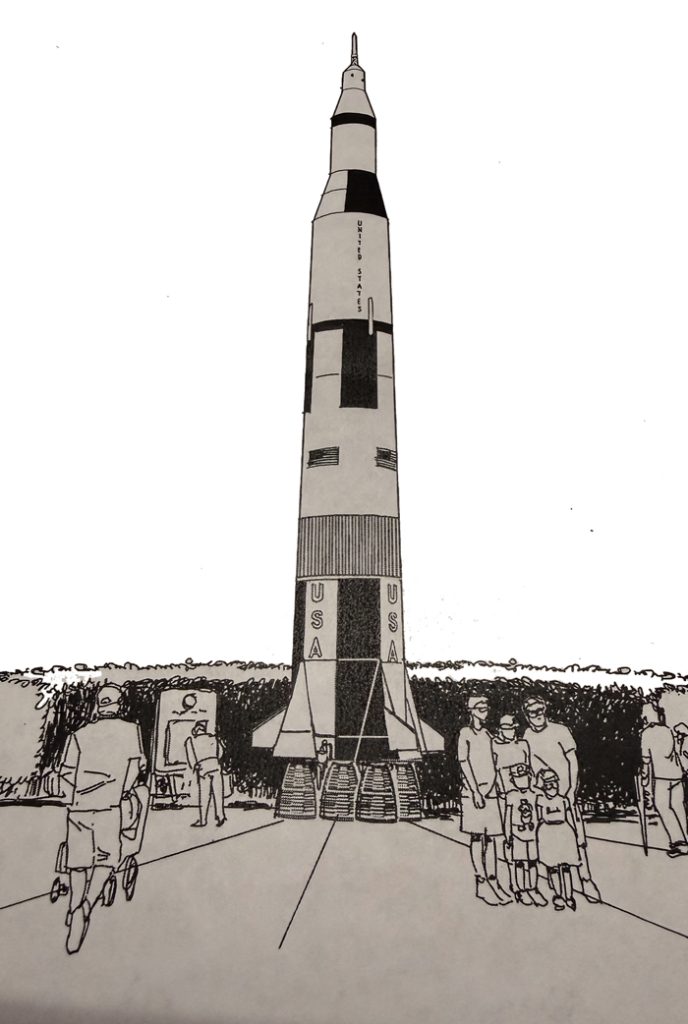
While the Apollo command module was being made in Downey, the Saturn Stage II booster rocket was being made in that tower. Aerospace was everywhere back then.
Without the power in that tower, Apollo could not have ever left Earth’s gravity.
The Apollo 11 astronauts themselves were so impressed with what the Rockwell team had done in Seal Beach that they came here personally in 1969 after their lunar mission to say thanks. That, my friends, is history, and history deserves proper documentation.
Among my fondest memories of reporting during the past decade is listening to the stories of many of the heroic men and women who made history.
People like the late Tom Logsdon, a geometric mathematician from eastern Kentucky who came out for a job and achieved global recognition.
Using a slide rule with pencil and paper, Logsdon calculated and sketched the orbital requirements of geosynchronous positioning of multiple satellites.
His company presented the design to the Pentagon in the 1970s, and it was selected to produce global positioning, without which our phones could not have maps.
The U.S. government and even the late Queen Elizabeth, among others, recognized Logsdon as one of the 30 inventors of GPS.
Just another Seal Beach resident who made undocumented history.
Tom’s story is not unlike thousands of other local heroes. Collectively, they came together to produce the thrust on which the American space program began to soar.
Without Seal Beach, Armstrong likely would never have set foot on the moon.
History is everywhere, yet a monument to what they did is nowhere.
As an advocate for such a monument, I met with Seal Beach resident Tim Prangley and his son Kevin, who also believe there should be one. “Generations of Seal Beach area families deserve a monument dedicated to the scientists and engineers who made massive contributions toward putting the first man on the moon,” he wrote in an essay he hoped to publish in the Sun.
“Since the space race, the corner of Seal Beach Boulevard and Westminster was home to monumental towers which housed the second stage of the Saturn V rocket, the engineering marvel that would be used throughout the Apollo program,” said Prangley.
Since the tower was removed a handful of years ago, the “only tribute from the Apollo project” is a street sign at Boeing across the street,” he said.
Prangley and his son had started collecting bios of people who worked on Apollo.
Hard to believe, is it not, that the only record of this entire era of U.S. history is a street sign?
Then COVID shut everything down, and the idea of the monument lost momentum, and I lost touch with the Prangleys.
Perhaps, however, with the Artemis II launch and the revival of NASA and the U.S. Space program, it may be worth reconsidering how best to remember what they did for this town and for this nation.
People living today will remember, but without a more celebrated monument, the achievements of thousands will fade into the din of history.
Their stories are compelling. The machinists of Seal Beach, the welders and engineers, the quality inspectors, the clerical workers, and the night-shift workers who drove home in the dark; all of them who live with the quiet pride of people who knew that they were doing the most important work of their age.
They deserve more than a paycheck and a memory.
That is the real tragedy. Not that the program ended. Not that the Apollo rockets stopped flying. Most tragic is that a community can pour a decade of its life into the greatest technological achievement in human history and leave not a single mark to prove it.
Saturn V still stands in Houston, Huntsville, and Cape Canaveral. Downey, where the command module was built, capitalized on its role with a museum complex that continues to grow.
Somewhere, perhaps in many places around Seal Beach, eighty-year-old men and women, who spent the best years of their lives in that matrix, watch the moon rise over the Pacific each night and know what they did.
As a community, we should consider honoring them while we can.
David N. Young is editor of our sister newspaper the Event-News Enterprise.