



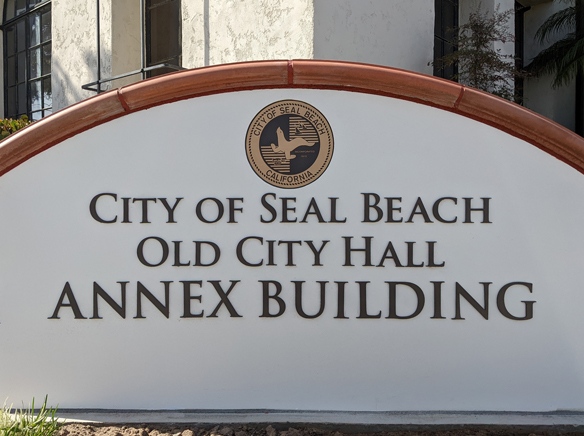
The City Council, Planning Commission, and public looked at state-mandated programs to increase housing in Seal Beach on Monday, July 20.
This was a joint study session only. The council took no action. The commission took no action.
The study session looked at some of the programs the city is required to implement because of the current Seal Beach Housing Element.
Any changes to the code will come to the council in the future.
The process began in 2021, according to Community Development Director Shaun Temple.
“We’ve actually accomplished a lot of it already,” Temple said.
According to Temple’s presentation to the joint study session, there are 18 actions that Seal Beach needs to complete to comply with the requirements of the state mandated updates to the Housing Element of the city’s General Plan. Those items include the city code updates (which include reducing parking requirements and reducing minimum unit size), lot splits (to allow housing to be built on both sides of the split), the Environmental Justice Element of the General Plan, and the Local Coastal Plan. “LCPs are land use planning documents that lay out a framework for development and coastal resource protection within a city or county’s coastal zone area,” according to the California Coastal Commission website. LCPs basically transfer some of the Coastal Commission’s authority to local communities.
According to Temple: The Local Coastal Plan is funded with a grant. The Environmental Justice Element of the General Plan is funded by building permits. Other costs include Seal Beach staff time.
Temple said the city had an excellent relationship with the Coastal Commission.
What could happen if Seal Beach didn’t comply? California recently filed lawsuits against five cities.
Comments
The following is not a transcript but highlights from the study session.
District Two Planning Commissioner Karen Nolta said she felt like the city’s hands were tied by the builder’s remedy.
(“The Builder’s Remedy limits a local government’s ability to reject projects that include certain affordable housing components even when they are inconsistent with the jurisdiction’s zoning ordinance or general plan,” according to a June 2025 letter from the California Attorney General’s Office.)
“I’m concerned about the character of our city, but I think it’s worse if we don’t pass this and do what they say,” Nolta said.
Later, Temple described the Housing Element programs not as a plan to build anything, but to remove barriers to property owners who choose to do projects.
According to City Attorney Nick Ghirelli there is new language in state law that California intends to supersede local standards, but they have not been tested in court.
District Four Councilwoman Patty Senecal asked if sewer connections would be required for accessory dwelling units. Temple said he would need to verify that but he suspected they do need sewer connections.
Ghirelli believed ADUs were required to have a sewer connection, but not junior ADUs.
District One Councilmember Joe Kalmick said in October, Seal Beach would be receiving the new number for the next Housing Element cycle. “Everything that I’ve been able to glean by being on the board of SCAG, the Southern California Association of Governments, who will issue those numbers, it could be disastrous,” Kalmick said.
(For the current Housing Element, Seal Beach was allotted a requirement to plan for the construction of 1,243 housing units. The city wasn’t required to actually build them.)
“From my personal perspective, any number greater than one is a problem,” Kalmick said.
“I would hate for us to go up because that would be the only way that we could implement a new RHNA number—that’s the Regional Housing Needs Assessment number—that we will be getting,” Kalmick said.
He expressed confidence that staff was keeping on top of the matter and letting the council know what was coming.
Councilwoman Patty Senecal raised concerns about sewer connections and budget impacts of the state housing requirements.
“I think the sewer system has really been overlooked,” she said. She also expressed concern about parking in the future. She speculated that Seal Beach might be looking at building a parking structure.
Theresa Miller said city officials should not be in a hurry to say they have no choice.
Background on some programs
“The City Council adopted the 2021-2029 Housing Element following an extensive public planning process,” according to the staff report by Community Development Director Shaun Temple.
The Housing Element is a state-mandated document that is part of the city’s General Plan.
The California Department of Housing and Community Development certified the Seal Beach Housing Element. The city updated the Zoning Code to get the certification.
In related news, Seal Beach submitted the 2025 Annual Progress Report to the California Department of Housing and Community Development on March 31, 2026.
Space makes it impossible to list all of the city programs to increase housing, but here are summaries of a few of them to give you an idea.
Program 1a of the Seal Beach Housing element aims to provide more housing through updates to the General Plan and Zoning Code.
Program 1c is to promote available housing incentives and evaluate their effectiveness, according to the Housing Element.
“Website updates by December 2024, evaluation on an ongoing annual basis. If available incentives demonstrate ineffectiveness by the end of the 2025 calendar year, the City will undertake revisions to available incentives in 2026,” according to the Housing Element.
Program 1d is to issue the annual progress report. As reported above, that’s been done.
Program 1e is to ensure no loss of housing.
According to the document, Seal Beach won’t reduce housing density unless the reduction is consistent with the General Plan and there are enough remaining cites to meet the RHNA allotment.