



With the same energy with which the public adopts Pandas, a baby penguin named “Ari,” born and bred in the Aquarium of the Pacific, seems destined to be a star.
“Get over here, that’s him (Ari),” says one woman, grabbing her friend, upon seeing the swimming chick. Nearby, a little girl, nestled within a group of little girls wearing red summer camp t-shirts talking among themselves, says, “I wish I could touch him.”
Ari, the Magellanic penguin, has been seemingly performing and entertaining guests of all ages since being allowed in the June Keyes Penguin Habitat for the first time on July 30.
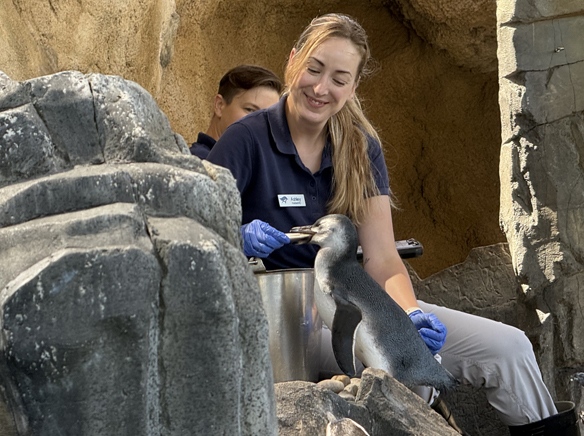
“Little Ari, the chick born three months ago to parent Penguins Kate and Robbie (the Aquarium’s Brazil rescue), has drawn big crowds and is a big hit,” according to Senior Agriculturist Ashley Loper, a Mississippi native whose job it is to facilitate the penguin habitat.
While most of the double-banded penguins swim leisurely through the massive tank like on a leisurely summer stroll, Ari is a bundle of energy, soaking up every morsel of the attention.
First, he zooms to the bottom of the tank, does a backflip, and surfaces so fast he leaves a trail of bubbles in his wake. He looks up, seemingly smiles, and does it again. Then he swims quickly on the surface across the front of the tank with his head slightly cocked as if to say hello to the throngs watching him.
“Penguins are very charismatic animals,” says Loper, “and I know many people come specifically to see them.” She says aquarium employees have heard visitors ask, “Can you tell me how to get to the penguin habitat?”
Loper said Magellanic penguins “break the mold” of what most people think about penguins. Because of movie depictions and other reasons, “most people think of snow and ice, which she said most penguins in the wild “won’t see in their entire lives.”
Even the penguins in Antarctica, she said, live mostly near rocky coasts and desert-like conditions. There are some cold-water penguins, the “big ones,” the Emperor penguins (often seen in movies); most penguin species are “warm water” animals, like the Humboldt, African and Galapagos, living near coasts where oceans constantly deliver fish.
While most warm water penguins have a single black band around their necks, the Magellanic penguins are unique.
“If you look closely, they have two black bands going across their chest. African penguins and Humboldt’s have only one, which is one of the ways you can identify a Magellanic penguin,” said Loper.
The bird is named for famed explorer Ferdinand Magellan, whose crew recorded them in 1520 during the circumnavigation as they rounded the tip of South America. Still today, the flocks are based in Chile and Argentina near the tip of South America.
“Kate and Robbie first paired up for breeding in 2022. After four years, this is their first chick that has successfully been hatched and raised. We are thrilled to welcome the new baby, which hatched on May 9, and now introduce him to his new home,” said Megan Smylie, Aquarium of the Pacific sea otter program manager, in a statement.
Well, a penguin is perhaps not as rare as a Panda being born in captivity, but the buzz is still significant.
So much so, said Loper, that the Aquarium has carved out a private “pad” for the Penguin couple inside the facility, “including a private pool, air conditioning and a very nice space,” where Ari was hatched.
Magellanic penguin chicks typically stay with their parents for one to two months, where they’ll grow to adult length (twenty-four to thirty inches) by the end of that time. Chicks are then moved to a behind-the-scenes penguin nursery, where they can safely learn how to swim and participate in feedings until they’re ready to join the adults in the Aquarium’s penguin habitat.
According to a study entitled “Born to be bold,” Ari’s standout behavior is not unexpected.
The study, performed by six leading Argentinian researchers, suggests some penguins are bold because “penguins have measurable, stable individual temperaments.”
When it came time to eat, Ari was a bit less bold, watching carefully as the mature penguins got their fresh, “restaurant-quality fish” from Ashley, then slowly waddled over for a few of his own.
To understand the wisdom of the animal kingdom, every day at 2:30 p.m. when the penguins are fed at the Judy Keyes Habitat area, brave seagulls fly in and perch on the rocks, hoping to make a meal of an errant fish.
Although penguins can live for 25 years or more, said Loper, noting that little Ari is still a growing penguin and acting every bit of his juvenile status.
Stardom may be too strong a word, but Ari is becoming quite the showman, exploring almost every face that comes to see him and performing magic swimming tricks only a penguin can manage.
For sure, the young penguin has a long journey ahead, but for now, he seems to love every swimming minute of it.