


By Emily Henderson
The neighborhood is deafeningly quiet.
White, beige, cream, eggshell townhouses line the pathways, matching the color of the beach floor that is only a few minutes away.
Families and couples walk along the tree-lined sidewalks with their pristinely upkept dogs, not a sound between them, or a woof from the furry friend; only the footsteps of their simple evening routines. A car wooshes by. Black, shiny, and quiet only in its luxury. The neighborhood is still, but that is only to the unsuspecting eye.
Quickly, the eye travels upward. A gleaming purple light comes from one of the balconies. Then orange. Then blue. A rainbow cacophony exploding from the ticky-tacky box.
Inside is no different. While the symphony of light is confined to a single room, the house is anything but dead. The soft thud of both small and large footsteps can be heard from all around, mixed with the metallic twang of a guitar being tuned; and laughter, so much laughter, creating a symphony of organized chaos. Two dogs, a large Golden Retriever named Mason and Mana, the small Catahoula-lab mix scamper to anyone that can offer a scratching hand. There is a flurry of movement at all points. Stillness is not a word known here.
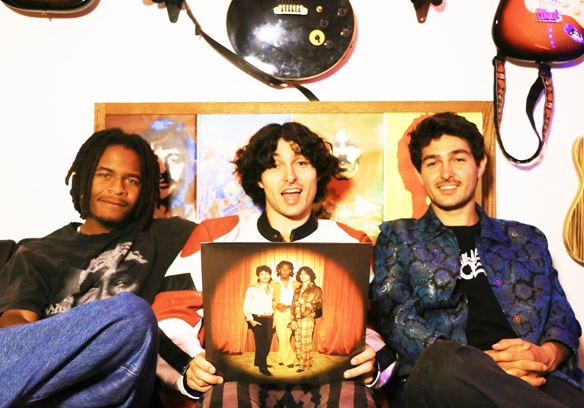
The rainbow colored room comes into full view. The instrument of choice, the guitar, is hung multiple times over on one of the walls. A low-lying couch with pillows strewn about takes up most of the space, with a psychedelic picture on top of it. Upon a closer look, it’s the Fab Four during their Sgt. Pepper’s period, a huge inspiration for those that inhabit the space. Placed in a small alcove is a glass-top desk with a large Mac desktop. The workplace: the stage in a small setting.
It is a home studio, the host explains. A place where he can record music to his heart’s content. He just set it up recently, an exciting new adventure. His name is Sean Bierman, a singer and guitarist, and one of the three members which pours out creativity into this abode. The other two are his twin brother singer and guitarist Chad Bierman, and their friend, bassist and keyboard player, Nonso Ikeji. They all make up the band, Familiar Faces.
Familiar Faces is a psychedelic-alternative-indie band, based in Long Beach, CA. According to their website, the band takes much inspiration from old and new sources alike, such as “Tame Impala, Led Zeppelin, Jimi Hendrix, and Jacob Collier.” The band emphasizes that “their songs resonate with the quintessential experiences of Southern California’s youth, navigating the spectrum of challenges and exhilaration it presents.” The band started in 2021 and have now released their debut album “In the Spotlight,” but it was a long road before they got anywhere near where they are right now.
Before there were three, there were two. The brother’s Bierman started off as a two-man act called, well, the Bierman Brothers. “We [have been] playing music since we were little kids,” Sean starts, saying how the brothers gained inspiration from their eldest brother Ryan Bierman, who was taking guitar lessons at the time. This continued well into their time at Huntington Beach High School, “They had a really good music program. We performed in that program. And that made us take it [really seriously],” Sean continues.
At the same time, Ikeji was just starting his musical journey—not playing until he was 16. Of course, he listened to music growing up. “Mostly rap and hip-hop” from the 90s and early 2000s, says Ikeji. But, he really has his mother to thank for getting him to where he is musically—by pushing him to join choir at Kennedy High School. “I didn’t necessarily want to because I was a basketball guy,” Ikeji continues. “I was a huge basketball and sports guy. I was like ‘Singin’? I’m not going to sing. Like, why would I do that? I’m a hooper. I play basketball. I don’t sing.’”
Despite his protests, the choir became a true outlet for him. Ikeji learned to sing, and—what would prove to be beneficial later—learned the piano, thanks to one of his friends. “He showed [me] the basic four notes on the left hand. Then, I started playing that and I went ‘This is kind of cool.’ Then, he showed me how to play the right hand. Then—it took me a few weeks—but I was finally able to put them together. I was hooked after that,” Ikeji remembers fondly. So, he went home and immediately had to find a piano. Good thing there was a brand-new one in the shed, thanks to his uncle, who bought it for Ikeji when he was born. A prophetic vision?
The love of music grew more and more with the twins. They had many small bands over the years, but the two always came back to the Bierman Brothers. Eventually, high school graduation grew closer and closer, and the brothers set their sights on Cypress, thanks to one of their high school music teachers. “It was [the] COVID[-19 pandemic]. Nobody was really in school. So, it did not really matter to go either to a community college or expensive college. We were saving money,” Sean continues.
Destiny must have been playing a hand, because the choice of going to Cypress College, led one of the brothers to meet with future band member Ikeji. “I met Ikeji in a Zoom class. We were both studying music there. It was funny. He was the only one on the call that did not have his camera on,” Sean laughs.
Ikeji joins in on the fun. “I was trying to rebel the whole time. I was like ‘You can not force me to show my face,’” he continues. The duo bonded over an icebreaker of their favorite musicians, cementing the collaboration even if they did not know it yet. Eventually the two met outside of the confines of a Zoom screen, with Sean running into class late one day, and sitting down next to the future bassist himself. “I recognized everybody, except Nonso. [I thought] ‘Wait, this must be the guy.’”
One Bierman introduced Ikeji to the other Bierman, and the three started playing originals the brothers had created earlier, right then and there. And, well, the rest is history.
A new family was created that day, and that idea has always been a part of Familiar Faces. Specifically, the brothers are not the only Bierman’s that work with the band. Mom and Dad Bierman—a.k.a Gabby and Dave Bierman—help with the booking and accounting; along with providing love and support like two parents do. Specifically with Gabby, Ikeji laments that even though she is not his biological mom, Gabby “pushes [the band] in aspects that [they] lack.” He continues, saying that “She helps us stay firm, stay alert, and stay on top of certain things that can easily slip if no one says anything about it. It’s good having her on the team.”
Dave is also a part of the foundation that makes Familiar Faces, by being an audio-visual wiz—with no experience in that department what-so-ever. “Honestly, he works the hardest at set-up,” says Chad. He continues, stating that Chad will “slack for one minute, and next thing he knows, [he will] look up, and all the speakers are already standing up and plugged in. Like ‘Jeez Dad! I feel bad!’ He’s a workhorse. He kills it.” The three nod their heads in uniformed agreement.
With the core being slowly shaped, Familiar Faces has been releasing a variety of songs since their initial start. Gaining influence from psychedelic and classic rock of the ’60s and ’70s, the band adds modern twists with the tools and techniques that are now available. “I think we are all old souls in the music-loving sense,” Sean professes. “It’s just trying to innovate those old sounds.”
But even with the similarities of music taste between the three, a true fan will note the distinctions that separate every member— and the band knows it too. With Chad, he is “more of the rocker and kind of into-pop-music guy;” He continues, saying that Sean is “more into-psychedelic-rock,” along with classic rock; with Ikeji interjecting saying that he likes to keep the music “funky.”
No matter the style, the band is trying to create something that they love, and hope fans love as well. Their newest album, “In the Spotlight,” is a reflection of that mindset. The debut is a culmination of many years of work, says Faces. Chad reminisces that many of the songs on the album he “remember[s] Sean producing in [his] bedroom in 2020, six years ago. [We were] feeling a lot.”
Those feelings, the different genres, and much more combine together to give inspiration to many of the songs between the three. Chad emotionally discusses his songwriting process. “You can’t force it out ever. That’s my experience at least.”
He continues, “We studied all this music theory stuff at Cypress College, and it’s helpful to know that. But at the end of the day, it does not help me write a song. It has to come out of you.” The others agree wholeheartedly.
The debut album is a particular science. A band has to do an impossible balancing act of trying to find a new audience, while also creating something they love and are proud of. Faces understood this task, and embedded much meaning onto every aspect of the album. Time was a great helper in this cause. “We just had so much time for this to brew. You have to pick so sparingly for your first album, because all the songs you have written in your life, this is the chance to narrow it down,” Sean expresses.
Chad continues saying how it took a while to even know how to make a good record. But they had a little help. He professes his gratitude for “Tayte Nickols, who produced most of the songs.” They were also mastered by Chief Engineer of Air Studios in London, John Webber, who helped bring the record to what it is now.
Their various musical influences are not the only key differences between the three. On-stage, the audience can acutely tell the personalities that are within each of the members. Ikeji puts it simply, “The reason the three of us work so well together is because of our different traits. [It’s] because Chad’s crazy, because Sean’s in the middle, and because I’m super laid back. You literally have the three.”
This semi-reflects who they are off-stage as well, with Sean talking about how when they were children, “Chad definitely was known as the crazy one, and I was the more shy one. Now, it’s not really that way. Depends on the day.”
What the band also professes is that if one wants to up the energy a bit more, the others know to give them their time to shine. Ikeji continues, saying that when they play, “everything is just in balance.”
But even with balance, between the three, their team, their fans, the prospect of the debut album, and much more, they are still young artists. The economy is dismal, artificial intelligence is destroying true art, and a million other problems of just being in your early 20s come about. The band realizes both the ups and downs of everyday life. Sean expresses that it is a “blessing and a curse to be in love with playing music, because I have to dedicate my life to this.”
He expands: “It’s a curse because I could easily [take] another career path; If I did not have this passion I probably would not feel like I was missing out on doing something else that is easier to make money. But unfortunately, that is just not the reality. Something tells me that I have to do music. But it’s a blessing. The fact to have a passion is a blessing; to have that energy added to your life. If I find myself not playing music for a while, I start to feel like [life is] lacking.” The drive to play is what fuels all of them. Music is their life. Familiar Faces is their life; and they are not going to stop this easily.
Specifically, Ikeji talks about a time when he was a manager at a local Target. He remembers, saying how he was at the store all the time, at early hours, but making lots of money. Once he joined Faces, he realized where his life should truly go, and the chain was not a part of it. “So, eventually, ultimately, I have to quit Target, because I was like ‘What [is] more important? This job, which I can just get again another time? Or music?’,” Ikeji professes.
Fiscally, the band understands that passion can not get you by in this economy, unfortunately. Every member has or is trying to get a full-time job, so they can keep doing what they truly love. Specifically, Ikeji works at a Boys and Girls Club, where he teaches a music class for the kids, hoping to inspire a future generation of musicians and give them the support he did not have when he was younger.
“I literally teach music to kids like Jack Black in School of Rock. I’ve never felt more fulfilled in my life [than] where I am right now.” Ikeji continues, “Yeah, I do not make nearly as much money as I was making before, but I am happy, and that is all that matters to me at this point. That is how I developed my passion, with seeing the spark in little kids.”
The future of Familiar Faces looks bright, and they are hoping for everything bigger and better in the years to come.
With the debut comes merch, selling the album on vinyl and on streaming, and touring—all while keeping authenticity at the forefront. It’s all about more, more, more with Familiar Faces, and, especially, Chad agrees. “We [are] taking baby steps, but I truly believe in us. I truly think we [are] going to make it, all the way,” he excitedly pronounces, almost like a declaration to all the world. Familiar Faces is here to stay.”
Now it is time to exit the colorful oasis. Descending down the steps, back into the blanket of darkness that is the outside world. Walking away, into the cold, what seems to be silence, is actually a hum; a whistle; a chord. The music is brewing. The best is yet to come.

