



The California Coastal Commission is scheduled to hold a public hearing on whether the Ocean Place project will get a coastal development permit on Wednesday, Oct. 9.
Ed Selich, project manager for the Bay City Partners, the business entity that owns the Old Town property that used to belong to the Los Angeles Department of Water and Power, said he notified the partners by email Monday morning, Sept. 23.
According to the Coastal Commission agenda for Oct. 9, the city of Seal Beach, the Bay City Partners and an entity known as Marina Beach House have applied for a coastal development permit on the land commonly referred to as the DWP site even though the property has not belonged to the DWP for decades.
In fact, the Coastal Commission agenda refers to the land as the DWP site.
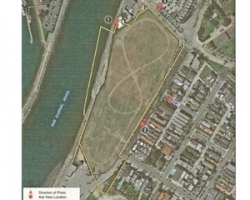
The agenda said the applicants want “to subdivide and develop (a) vacant 10.9 acre waterfront property (known as the DWP site) including public trust lands with 4.5 acre 32-lot residential development and 6.4 acre passive open space area, located at Southwest corner of 1st St. and Marina Dr., Seal Beach, Orange County.”
In July 2012, the Seal Beach City Council voted to change the zoning of the land to allow construction of residential housing—on the condition that the Bay City Partners give the city 6.4 acres of land to be developed for a park.
The Bay City Partners agreed on the condition that the city will only get the land if the Coastal Commission issues a development permit.
Seal Beach area opponents of the project have accused city officials of being illegally pre-committed to approving the project.
Some of those opponents included City Council-appointed members of the Tree Advisory Committee, the DWP (site) Committee, the Environmental Quality Control Board and the Recreation and Parks Commission.
Controversies over the property boundaries and the definitions of the open space area versus the development area hovered over the proposed project for about two years before the council agreed to allow residential development.
Opponents of the project would have preferred 70 percent of the original land parcel to be open space with 30 percent devoted to a hotel use.
The original specific plan for the site called for only the smaller part of the land to be developed and only as a hotel. However, the plan apparently did not clearly specify the boundaries of the open space and hotel portions of the property.
Also, some residents living in houses near the property were opposed to a hotel development.
In June 2012, Planning Commission members, residents and a consultant debated the proposed elimination of the hotel development. Supporters of the project argued that a hotel was not financially viable.
Some opponents argued that a hotel was viable; others argued that it didn’t matter because the property owners knew the land was zoned for a hotel development when they bought the land.
On April 25, the Seal Beach Environmental Quality Control Board voted 4-1 to advise the City Council that the Environmental Impact Report was inadequate.
Board Chairman Mario Voce, who testified against the project at an earlier meeting of the DWP Advisory Committee, criticized the EIR and said he stopped reading it.