



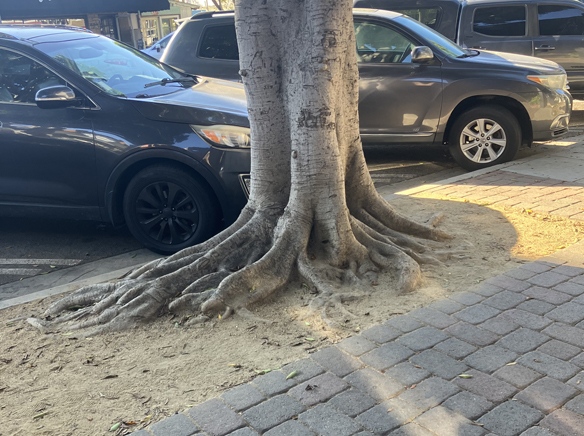
A lawyer is suing Seal Beach for damage he argues was caused by the roots of a Main Street ficus tree. Howard Brief owns a property at 222 Main, according to court papers. Brief is an attorney at law, real estate broker and notary, according to his office door. The California Bar Association website lists his law license as active. The lawsuit also asserts that ficus tree roots continue to trespass on his property. His complaint accuses the city of damaging his property without just compensation. The legal term is “inverse conversion.”
The complaint is against the city and 50 individuals identified as “does” (as in Jane Doe or John Doe).
“The City Clerk’s office informed me that a lawsuit regarding ficus trees on Main Street was delivered to their office on Thursday, May 28th,” wrote Seal Beach City Attorney Nicholas Ghirelli on June 1 of this year.
The city released a copy of the complaint and related documents, 25 pages in all, on Thursday, June 18, 2026, in response to a Public Records Act request.
Brief is seeking unspecified general and specific damages. Brief is asking for “injunctive relief requiring abatement.” According to the Legal Information Institute, “injunctive relief” means a court order.
“Abatement in property law can also refer to an available remedy for public nuisance which requires either the government or the responsible individual to reduce the nuisance,” according to the LII website.
Brief is also seeking court costs, the costs for repair “and diminution [sic] of the value of the property” and other relief the court “deems just and necessary.”
According to Brief’s complaint, the Seal Beach city government selected, planted, and was responsible for ficus trees on public property next to private property, specifically citing his building at 222 Main St.
According to Brief’s complaint, the “invasive root systems” of ficus trees are known in the fields of aboriculture [sic], city planning and Public Works programs for damaging foundations, damaging plumbing, damaging gas and waters systems. The complaint argues that the city, through its Public Works, engineering and urban forestry programs, knew or should have known the risks of planning ficus trees close to private property.
The complaint also asserts that “numerous property owners along Main Street and nearby commercial areas submitted similar complaints to the City regarding root related damage of foundations, sidewalk and structural displacement and plumbing intrusions caused by the Ficus Microcarpa (Indian Laurel Fig) trees prior to the damage suffered by Plaintiff to his property.”
The legal document argued that those complaints provided Seal Beach with actual notice of a recurring problem. According to the complaint, the city did not take protective measures such as removing the trees or putting in root barriers, inspections, root management protocols, or redesign planting areas next to what the document called “property improvements.”
The causes of action listed in the complaint include an assertion of a dangerous condition of public property (the trees and the roots of the trees), negligence, continuing trespass on Brief’s private property, and a continuing nuisance.
Brief filed a notice of a claim with Seal Beach on Feb. 11, 2026. The claim said a city-owned tree had grown under 222 Main and into the alley, damaging the plumbing, the foundation, structure walls, and the rear parking pad.
The filed claim form showed an X on the space next to the sentence: “The amount claimed is more than $25,000; jurisdiction rests in Superior Court.”
According to the claim, the loss is continuing.
The case is Brief versus city of Seal Beach. The case number is 30-2026-01570411-CUP-PO-CJC.
Background
The Seal Beach City Council voted 4-1 in February 2012 to approve a project to remove all non-ficus trees on Main Street and replace them entirely with ficus. According to the Feb. 27, 2012 minutes, 25 ficus trees were approved for planning. Then-District One Councilwoman Ellery Deaton argued in favor of the ficus trees. Then-District Five Councilman/Mayor Michael Levitt opposed planting the trees and requiring all businesses to have a tree in front of their business, according to the minutes. Jim Caviola, a member of the Tree Advisory Board, argued in favor of the ficus trees. Levitt cast the lone dissenting vote against the project.
The issue returned to the council on March 12, 2012, when the council approved an additional $115,000 for the project. Levitt pulled the item for more discussion. However, on that night the council voted unanimously to approve the money.
The issue came back to the council again on March 26, 2012, because Levitt requested further discussion of the ficus trees on Main.
Levitt proposed looking for a less disruptive tree than the ficus.
Deaton argued that the city should plant new trees and see if the plan worked. She said the city could remove problem trees.
According to the minutes for March 26, 2012, Levitt moved to have further study of the type of trees that should be planted on Main Street. Then-District Four Councilman Gary Miller seconded the motion. The vote was 2 in favor of the motion and 3 against. The proposal failed. According to the minutes, 11 individuals spoke against the ficus trees and four spoke in favor. Then the council voted to move forward with the Main Street tree project. The vote was 3-2 in favor.