


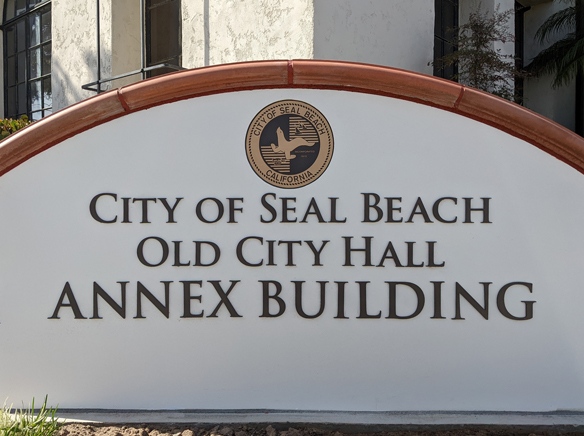
The Seal Beach City Council on Monday, Sept. 8, 2025, voted unanimously to formally make notice of the council’s intent to override the OC Airport Land Use Commission. This was the last item on the agenda of a nearly three-hour meeting.
The Orange County Airport Land Use Commission recently determined that several city documents were inconsistent with the JFTB Airport Environs Land Use Plan.
Those documents were the Housing Element (which still hasn’t been certified by the state government), the citywide Zoning Code Amendment, and the Main Street Specific Plan Amendment.
The process doesn’t end there. The city manager will submit the council resolution to the county Airport Land Use Commission. The city manager will then schedule a public hearing at a future city council meeting.
Council and public comments
Patty Campbell of College Park East raised concerns about the city’s liability in the event that there was a plane crash in the area of Old Ranch Country Club following a council decision to override of the county airport commission.
Interim Community Development Director Shaun Temple said the Old Ranch project was a separate project with its own EIR.
During his presentation to the council, Temple argued that the Airport Land Use Commission’s letter determining the Seal Beach documents were not consistent with the Airport Environs Land Use Plan did not provide written findings.
District Four Councilwoman Patty Senecal, who participated in the meeting remotely, said the council was only voting to notice the intent to override. “I have a lot of concerns about overriding a government agency that’s been around since 1967,” Senecal said.
Senecal and District Five Councilman Nathan Steele both said they wanted to hear from experts.
Background
The following contains highlights from the staff report to the City Council meeting, not the entire text.
“The Orange County Airport Land Use Commission (ALUC) is an advisory committee created by the Public Utilities Code (PUC) to assist local agencies in ensuring compatible land uses. This is done primarily through their adoption of a land use compatibility plan, known in Orange County as the Airport Environs Land Use Plan (AELUP) for the Joint Forces Training Base Los Alamitos (JFTB), against which proposed land uses are compared and evaluated for consistency,” according to the staff report prepared by Interim Community Development Director Shaun Temple.
“The AELUP includes a variety of information designed to help development surrounding the JFTB be compatible with the airport use, including heights, noise, and general safety,” Temple wrote.
Seal Beach submitted the 2021-2029 Housing Element to the county commission on Feb. 1, 2022, according to Temple’s report.
The commission found the Housing Element inconsistent with the airport environs plan on Feb. 17. The City Council overruled the airport commission on Aug. 29, 2022.
“Following a series of revisions to achieve certification from the California Department of Housing and Community Development (HCD), the 2021-2029 Housing Element was again submitted to the ALUC for consideration, along with the necessary Zoning Code Amendment and Main Street Specific Plan (MSSP) Amendment that must be implemented in order to remain compliant with State law and create opportunities for housing development,” Temple wrote.
“All three items were referred to the ALUC on April 24, 2025 and heard at its August 7, 2025 meeting,” Temple wrote.
“The AELUP defines acceptable height limits in the areas surrounding the JFTB in
order to accommodate takeoff and landing of aircraft,” Temple wrote.
“The height restrictions related to the identified Housing Element sites, the Zoning Code Amendment, and the MSSP Amendment are consistent with the AELUP, which is documented in the ALUC staff report,” Temple wrote.
“The AELUP uses the Community Noise Equivalent Level (CNEL) system for measuring noise impacts, which is a weighted average of noise over time,” Temple wrote.
“Two Housing Element sites are partially within the conditionally consistent 60 dBA CNEL zone: the Old Ranch Town Center and the Old Ranch Country Club,” Temple wrote.
“However, residential uses are not outright prohibited by the AELUP. Instead, they are required to be developed with insulation systems that bring the sound attenuation to no more than 45 dB inside, a requirement that is consistent with the City’s General Plan Noise Element and the AELUP requirements,” Temple wrote.
Temple’s report argues that the Housing Element, Zoning Code Amendment, and Main Street Specific Plan Amendment are consistent with the airport environs plan.
“All proposed development sites comply with the noise criteria, height limitations, and safety standards set forth in the AELUP,” Temple wrote.
Liability
“During Council discussion on August 11, 2025 related to an update on the Housing Element, questions regarding liability were raised,” Temple wrote.
“PUC [Public Utilities Code] Section 21678 states that if the City overrides ALUC’s action or recommendation, the operator of the airport shall be immune to liability from damages to property or personal injury caused by or resulting directly or indirectly from the City’s decision to overrule the ALUC determination,” Temple wrote.
“The discussion of liability is a complex one, particularly in this case, where the airport is operated by the military, specifically the U.S. Army. Generally speaking, the U.S. Government is already exempt from liability for accidents resulting from military activities. The PUC [Public Utilities Code] does not provide immunity to any other entities, including other aircraft operators. Further, the Government Code generally grants jurisdictions immunity from tort liability related to the issuance of a permit, such as a building permit, and the exercise of discretionary decision-making, such as the adoption of a land use plan. Ultimately, developers assume liability for their projects,” Temple wrote.
Once the OC Airport Land Use Commission receives the Seal Beach City Council resolution of intent to overrule the ALUC, the commission has 30 days to provide comments to Seal Beach.
Any comments would have to be included in the public record of any final decision the council makes, according to Temple’s report.
Alternatives
“The City Council may decide not to overrule ALUC’s determination of inconsistency. One option is to identify alternative sites for new housing units that HCD would find acceptable, amend the Housing Element, and submit it to HCD for consideration. Much like the process that unfolded over the last four years, staff expects such an option would take years to accomplish, placing the City at risk of fines, litigation, and builder’s remedy projects. Additionally, the current EIR would need to be updated, and a new one may need to be completed,” Temple wrote.
“This action would not guarantee a finding of consistency from the ALUC, particularly as the ALUC has not provided specific findings related to the AELUP that can be addressed,” Temple wrote.
“The City Council may also choose to take no action,” Temple wrote.
However, staff did not recommend that option. According to Temple, the Airport Land Use Commission could impose a requirement that Seal Beach submit all land use actions and permits to the ALUC under the Public Utilities Code. That would delay building in Seal Beach.

