



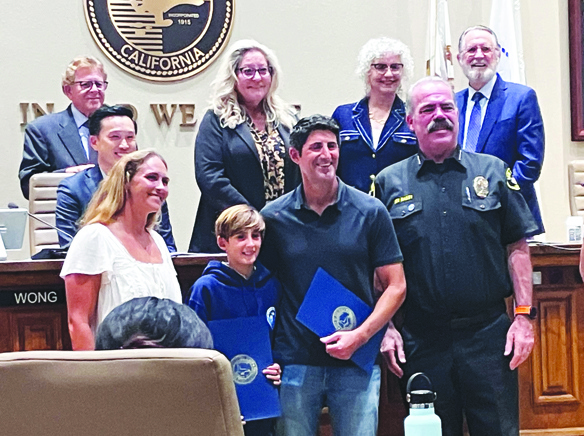
The council on Oct. 12 recognized a Junior Lifeguard and his father for saving five lives from a rip current north of the Seal Beach Pier.
Around 5 p.m., Aug. 30, 10-year-old Anthony Guzzetta, a recent graduate of the Junior Lifeguard program, and his father Jerome were swimming with a boogie board and a handheld swim-assist glove when they heard two adults shouting for help. The man and woman were being pulled rapidly out to sea by a rip current and were clearly in distress.
Anthony and Jerome immediately entered the current. Anthony handed his boogie board to the woman and gave the man his swim-assist glove, then instructed both adults on how to swim out of the current. Father and son guided the pair safely back to shore.
Moments later, in a separate incident, three 15-year-old individuals were caught in the same rip current. One teen was swept more than 100 yards offshore and was unable to swim back. Anthony and Jerome again entered the current, providing flotation devices to two of the teens. Anthony then swam ashore to alert Lifeguards, who were already assisting other swimmers.
According to the council proclamation, Anthony showed “exceptional calmness” and “seamless teamwork” with his father.
Seal Beach Lifeguards responded immediately, swimming out to the third teen who was slipping underwater and close to drowning. Using a flotation device, Lifeguards pulled the teen from the current and brought him safely to shore.
Anthony, described as an exceptionally strong swimmer for his age, recently completed the Seal Beach Junior Lifeguard program, where he learned how to identify rip currents and escape them safely. Jerome, a county firefighter who was off duty at the time, said he was proud of his son’s calmness and skill during both rescues.
“Anthony knew exactly what to do,” Jerome Guzzetta said. “He’s really good at spotting rip currents thanks to the Junior Lifeguard training.”
“The story isn’t so much about us as about the program here in Seal Beach,” Jerome Guzzetta told the council Monday night.
Jerome Guzzetta thanked the council for the recognition.
“Rip currents are powerful, channeled currents of water flowing away from shore. They typically extend from the shoreline, through the surf zone, and past the line of breaking waves. Rip currents can occur at any beach with breaking waves, including the Great Lakes,” according to the National Oceanic and Atmospheric Administration website.
“They are particularly dangerous for weak or non-swimmers, but a strong rip current is a hazard for even experienced swimmers. Rip current speeds are typically 1-2 feet per second, but speeds as high as 8 feet per second have been measured. That is faster than an Olympic swimmer,” the NOAA website said.
According to the U.S. Lifesaving Association, rip currents account for roughly 80% of ocean rescues nationwide and are responsible for a significant number of drownings each year.