



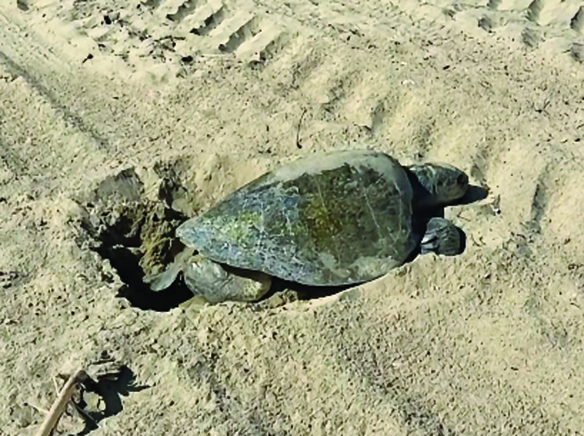
The National Oceanic and Atmospheric Administration reported on Sept. 21 that an olive ridley sea turtle made a nest for her eggs near Seal Beach. The NOAA social media post said the eggs were buried on the sand on Sept. 16.
“This is the first-ever recorded natural nesting for any sea turtle species on the U.S. West Coast,” according to the NOAA post.
“Three days later, a sea turtle was observed again on the beach a few miles south, near the Huntington Beach Pier. It is unclear at this time, whether this is the same or a different turtle,” according to NOAA.
“Our team of local, state, and federal partners will monitor the nesting sites throughout the incubation period, which typically lasts for 45-60 days. Both areas are fenced, protected, and have interpretive signage. We urge beach goers to steer clear and not disturb the sites,” according to NOAA.
“Olive ridley turtles are the smallest of the sea turtles: adults weigh up to 100 lbs and are about 2.5 to 3’ in length. They are estimated to live about 30-50 years,” according to NOAA.
“While occasionally seen in Southern California following warm currents, this species has never been documented to nest in the United States,” according to NOAA.
The federal agency advises members of the public to stay away from nesting sites.
If you find a sea turtle, NOAA asks the public to call NOAA Fisheries West Coast Stranding Hotline at (562) 506-4315.
“A big thank you to our partners U.S. Fish and Wildlife Service, California Department of Fish and Wildlife, Huntington Beach lifeguards, City of Huntington Beach – Government, Huntington Beach Fire Department, Bolsa Chica Ecological Preserve, US Navy Seal Beach, Seal Beach Marine Safety Department, City of Seal Beach – Local Government, Surfside lifeguards, Surfside Colony Community Association, Aquarium of the Pacific and many others for their quick response and for helping monitor these important sites,” according to NOAA.
“Sea turtles are protected under the Endangered Species Act. All accompanying media was taken by the inter-agency team in the process of monitoring and protecting the turtles. We remind the public to keep a respectful distance and not to disturb the fenced and protected nesting sites,” according to NOAA.