



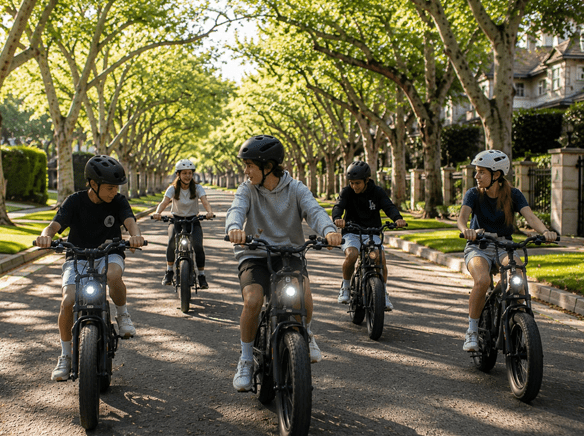
At their June meeting, the Rossmoor Community Services District passed measures as strong as state law allowed to stave off additional damage e-bikers can create in the district’s parks and give the law enforcement tools, even if small, to prevent the marauding behavior in their neighborhoods being witnessed by some in the community.
At the most recent meeting of the Cypress City Council, a representative of the Cal Cities coalition gave them a report on pending e-bike legislation, saying the issue of e-bike safety “has been raised throughout the state of California, not just Orange County.”
Last month, the Los Alamitos Police Department held a town hall, and again, electric bike safety came up as a major issue. In this case, the Los Alamitos City Council had passed ordinances early in 2025 to give officers tools to control the growing problem of e-bikes.
Thus far, judging from the officers’ testimonials, ordinances alone are unlikely to solve the problem, as e-bikes pose a variety of threats that they are grappling with and trying to control effectively.
Taken together, it is obvious that electronic bike regulation has become one of, if not the, most pressing problems facing local governments across the state.
Connor Medina, regional manager of Cal Cities (483 California cities), appeared before the Cypress City Council at their request to report on pending legislation to control e-bikes.
Based on Medina’s report, here are the bills currently under consideration:
• AB1614 – prohibits piggybacking on e-bike trails.
• AB1569 – establishes a statewide e-bike safety training course for middle and high school students.
• AB 2346 – sets speed limits on e-bike paths and sidewalks and requires accurate information from sellers.
• SB1167 – aims to limit misleading advertising and enforce e-bike speed limits.
• AB5 44 – requires red reflectors on e-bikes at all times of the day and cracking down on apps that claim you can increase the speed of your e-bike.
Medina said he would stay in close touch with City Manager Shannon DeLong as the legislation makes its way through the process, or not.
“This is a hotbed topic for Orange County,” said Mayor Pro-tem Dr. Kyle Chang, “and also in Cypress. It’s something that we, as a council, have thought about trying to pass a new city ordinance, but we haven’t gotten there yet,” he told Medina.
“I did have some questions about what’s going on in the state level and whether we can expect those changes anytime soon. One was raising the age limit for Class II e-bikes. These are the bikes that you don’t have to necessarily pedal to get up to 20 miles per hour,” Chang wanted to know.
“That’s a great question, Mayor Pro Tem. In terms of the age limit, there have been discussions. No legislation has advanced in terms of having an age limit,” he told Chang.
“That was amended out of the bill in committee, so there is a lot of work to do in terms of expressing, you know, why those sorts of requirements might be needed, but no, no movement at this time on that,” Medina told Chang.
Council member David Burke followed up.
“One of the reasons we wanted you here is that this is an issue that comes up a lot from residents, and so I appreciate the update on what some of the bills being considered are because, as we consider actions here in Cypress, we don’t want to consider something that might be in conflict with a state law that could pass the next day or anything of that nature,” said Burke.
“But my main question is, as Mayor Pro Tem Chang alluded, a number of cities have passed ordinances, whether it’s tougher penalties or speed limits or things of that nature,” said Burke, asking Medina if Cal Cities has any data yet on what measures have been effective for municipal governments when it comes to slowing down the e-bikes.
Media said with the explosion of e-bike ownership, government regulation, he thought, was still in its infancy.
“I think we’re still in a nascent period where different cities are trying different things,” he told Burke.
“From Cal City’s perspective, I think it’s very important that what we’re supporting is not preempting ideas that some cities have that might be going a little further, and different cities, different approaches,” he said.
“I’m not entirely sure if there is data on those particulars”, said Medina, promising to get back to Burke on the question of data.
Just a few weeks ago, residents showed up for a Los Al Police Town Hall that somehow morphed into a discussion of e-bikers and the growing problem associated with them.
Charlene Wood, a resident, said e-bikers saw her walking to church. “Instead of slowing down, they just sped up. It is very dangerous for us pedestrians walking,” she told the panel of police.
Capt. Kane Gallaugher told her while the Council had indeed passed ordinances, the problem of enforcement remains unsolved, and as Wood said, as soon as you call to report them, they’re already out of sight.
To the Council’s credit, they used a Grand Jury report on the problems with e-bikes in Orange County to model ordinances that were passed in 2025.
“In response to the grand jury report, our city develops specific municipal codes,” said Gallaugher. However, residents should also understand that “just simply creating these municipal codes will not alleviate the problem.:
If anything, the department said that many times during the elongated discussion about e-bikers and the problems they are causing.
Even though they are deploying more officers, catching up to them is truly a problem.
“We also are deploying additional officers to reach more areas,” he said, “but you know the challenge with some of the e-bikes, and bicycles, is when you’re in a car you can’t go everywhere they can on a bike and when you’re on foot, you’re not going to catch up with somebody on an e-bike,” said Gallaugher.
“I know that the state as well as the nation, I know it in California, they are looking into additional regulation,” he said.
Gallaugher said that’s why the department developed a phased approach, working with the Los Alamitos Unified School District to provide safety training to e-bikers, he said.
Police Chief Michael Claborn said the problem is indeed safety, but also hinted residents were for enforcement until their kids received a citation.
Claborn said when e-bikes first started becoming a problem, we developed an educational component, adding to Gallaugher’s remarks.
Claborn said Los Alamitos cooperated and made it mandatory for students who wanted a permit for their bike or e-bike to be at school; they had to first complete one of the courses.
However, “when we dove into the enforcement phase of the e-bike problem, every single one of the parents who received that ticket in the citation called to complain, yet we get complaints from parents all the time about what these e-bikes are doing to terrorize the community,” said Claborn.
“We try to educate them and after education comes enforcement,” said Claborn.
“When it came to enforcement, we got a lot of backlash and complaints, so if you could help us advocate in the community, we would appreciate it,” the police chief told residents.
“When it comes time and your neighbor says, ‘Can you believe my kid got a ticket,’ and you say,’ Yes, I absolutely can. Please keep your kid off the sidewalk,’ maybe then the enforcement model will change,” he said.