



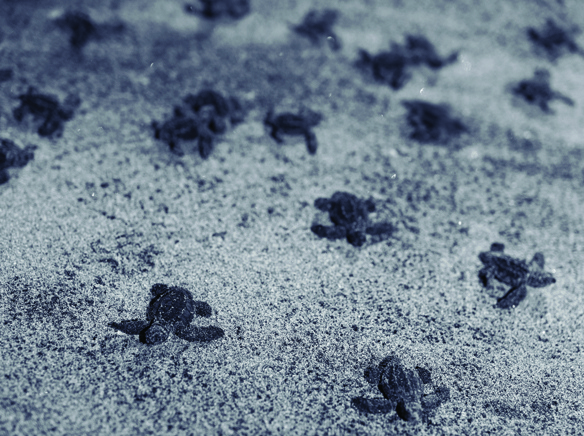
Olive ridley sea turtle hatchlings have been released to the wild after eggs were successfully hatched at the non-profit Aquarium of the Pacific. In an unprecedented event, two olive ridley sea turtle nests were discovered in mid-September in Seal Beach and Huntington Beach, California. The discovery represents the first-ever confirmed instance of natural sea turtle nesting on the U.S. West Coast. The eggs were then relocated to the Aquarium for protection due to a tropical storm. The Aquarium was selected to care for the sea turtle eggs due to its expertise and resources for animal care.
“We’re pleased that some sea turtle eggs were viable and have not only already successfully hatched, but the hatchlings have also made their journey across the sand to the ocean,” said Dr. Lance Adams, Aquarium of the Pacific director of veterinary services.
The eggs were kept in closed incubators under sand while Aquarium staff monitored them in a secure, temperature and humidity-controlled room in the Molina Animal Care Center. The eggs were relocated to the Aquarium because nests were at risk of being destroyed or washed away due to tropical storms. Federal officials and local partners, led by U.S. Fish and Wildlife Service, made the decision to relocate the eggs, and early on Friday, September 25, biologists carefully collected the eggs from Huntington Beach and Seal Beach and transferred them to the Aquarium of the Pacific. Later with tropical storm Rachel, both Seal Beach and Huntington Beach also documented high surf and standing water in the vicinity of the nests after the storm.
It is not known why these turtles chose Southern California beaches as nesting sites, but it may indicate an important historical change that could have long-term implications for the species and for local sea turtle management and protection. Olive ridleys are one of the smallest sea turtles, found in the tropical and warm waters of the Pacific, Atlantic, and Indian Oceans. Their breeding colony populations on the Pacific coast of Mexico are listed as endangered; all others are listed as threatened. Olive ridley nesting season in Mexico runs from July to December.
“Whether the reason for the nests in Southern California was because of our weather patterns, or a simple anomaly, this is an important conservation story,” said Jeff Flocken, Aquarium of the Pacific president and CEO. “Species that change and adapt are the ones that survive.”
On November 1, a third nest was documented to the north, in Ventura County. There may be additional turtles that will nest or have already nested on Southern California beaches. The public should be on the lookout for sea turtle tracks in the sand. If the public sees a sea turtle nesting, in distress, or suspects they have found a nest, they should notify a local lifeguard or call the 24/7 West Coast Sea Turtle Stranding Hotline: 562-506-4315. Sea turtles are protected and should not be disturbed or harassed. Keep a safe distance from wildlife. Share photos and sightings online at: fisheries.noaa.gov/west-coast/science-data/green-turtle-research-and-conservation-southern-california
Collaborating partners in this effort include: the National Oceanic and Atmospheric Administration Fisheries, U.S. Fish and Wildlife Service, California Department of Fish and Wildlife, Huntington Beach Fire Department Marine Safety, City of Huntington Beach – Government, Huntington Beach Fire Department, Bolsa Chica Ecological Preserve, US Navy Seal Beach, Seal Beach Marine Safety Department, City of Seal Beach – Local Government, Surfside lifeguards, and Surfside Colony Community Association.
Like every sea turtle hatchling that makes it to the ocean, olive ridleys have a formidable journey to avoid predation in the wild, find safety and food, and adapt to their changing environment. Hatchlings position themselves seaward and crawl toward the open horizon over the ocean. From there, they swim continuously for days away from the shore until they reach deeper waters. Sea turtle hatchlings have a very low survival rate in the wild: it is estimated that only one in 1,000 olive ridley sea turtle hatchlings reach adulthood.