



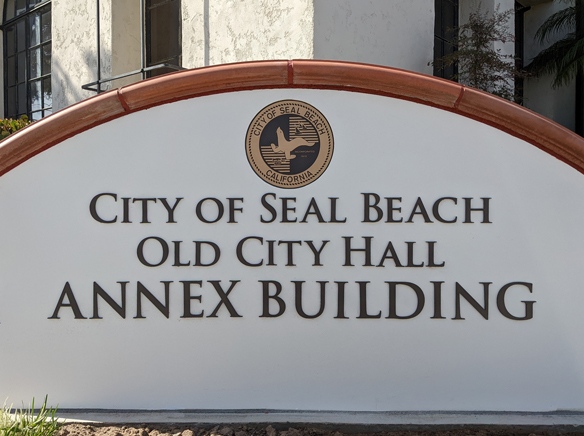
The council on Oct. 12 introduced an ordinance regulating nonfunctional turf irrigation. The ordinance was required by Assembly Bill 1572. The ordinance will return to the council for adoption at a future date.
The vote was 4 to 1, with District Five Councilman Nathan Steele casting the dissenting vote.
Senior Engineer David Spitz told the council there wasn’t much guidance on how the city had to regulate the use of ornamental turf. The state government basically doesn’t want cities to put drinking water on turf that is purely ornamental.
The city had until the first day of 2027 to get this done.
He said there were rebate programs available for removing nonfunctional turf. Spitz said Seal Beach obtained rebates for three locations in town. Spitz put the cost around six digits.
District Three Councilwoman/Mayor Lisa Landau said this was “another” unfunded mandate. Spitz confirmed that. She asked about local control. Spitz said the state was counting on cities to develop and run the regulation programs themselves.
He said the Community Development Department would be in charge of enforcement. Landau said the city can’t keep up with inspections. She said to be in compliance, the city would have to hire someone. Spitz said consultants can be hired through the Municipal Water District of Orange County.
Councilman Steele said the water in Seal Beach comes out of the North Orange County aquifer. Steele said he believes 90% of the city’s water comes out of that aquifer. “Can we export water out of our aquifer to Bakersfield where they need it?” Steele asked.
According to Spitz, there was no facility he knew of that could transfer water.
Steele said Sacramento puts all of California “in one basket.” He said Seal Beach’s water supply did nothing for the state’s overall water supply.
Spitz agreed with him.
Steele said even if the city gets reimbursed, it was taxpayer money that is going for something that doesn’t serve the function it’s meant to serve.
Background
“‘Making Conservation a California Way of Life’ is the long-term water use framework the State has adopted,” according to the staff report prepared by Spitz.
“Water conservation regulations under Senate Bill 606 and Assembly Bill 1668 in 2018 were some of the first state regulations on how Californians are allowed to use potable, drinking water. Recently, AB 1572 was signed into law, which continues the State’s push for increased water conservation,” Spitz wrote.
According to the report, AB 1572 does not allow using drinking water to water non-functional turf on government property.
“NFT refers to grassy areas that are ornamental in nature, areas that do not provide a recreational or community purpose and grass irrigated solely for aesthetics such as street medians, parkways, business and industrial parks, and parking lots,” Spitz wrote.
According to the report, AB 1572 includes exemptions for homes, to protect the health of trees and perennial plants, cemeteries, and the State Water Resources Control Board has authority to extend compliance deadlines by up to three years in cases of hardship.
“Section 9.35 of the Seal Beach Municipal Code pertains to Water Conservation and includes permanent water conservation requirement measures that are currently in effect. Staff recommends amending Section 9.35 to include all requirements of AB 1572 including related definitions, as noted in the proposed ordinance,” Spitz wrote.
“The proposed ordinance will ensure City compliance with State law, allow for the City to determine appropriate enforcement measures, and avoid potential penalties from the State,” Spitz wrote. According to his report, there is no direct financial impact for approving the ordinance.