



Third in a series.
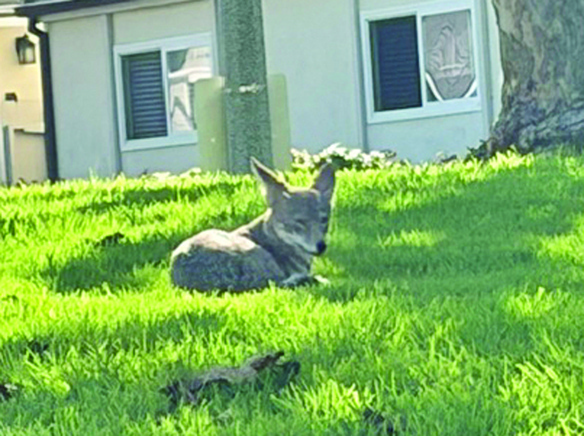
Some Seal Beach residents have said that people have been feeding coyotes in town. The comments have been made to the paper and on social media.
Feeding wildlife is against state law. (Technically, feeding humming birds is also illegal though enforcement is apparently rare.)
The Seal Beach city code also specifically forbids feeding wildlife, period. But there’s no penalty in the code.
“You are correct that Section 7.05.100 does not include a penalty within that specific provision,” wrote Capt. Nick Nicholas on Aug. 3.
He wrote that under Municipal Code Section 7.05.010, feeding a “nondomestic animal” would be an infraction.
“Accordingly, feeding or providing food to a coyote is prohibited by Section 7.05.100 and may be addressed as an infraction or through the City’s administrative-citation process,” Nicholas wrote.
“The practical limitation is that, as a general rule, a peace officer cannot make a warrantless arrest or issue a criminal citation for a misdemeanor or infraction that was not committed in the officer’s presence,” Nicholas wrote.
“Therefore, social media posts or a report that someone may be feeding coyotes would not, by themselves, ordinarily allow an officer to issue an infraction citation. An officer could investigate the report, contact the person involved, explain the ordinance, document the circumstances, and seek voluntary compliance. If an officer personally observed the person feeding a coyote, the officer could take appropriate enforcement action,” Nicholas wrote.
“In most situations, our immediate priority would be stopping the feeding, educating the person about the public-safety consequences, and documenting the incident so that repeated conduct can be appropriately addressed,” Nicholas wrote.
The Seal Beach Coyote Management Plan also addresses feeding coyotes.
“The act of feeding wildlife is known to lead to an increase in wildlife activity. Feeding can attract coyotes and their prey to an area leading to an increased likelihood of creating a habituated coyote(s) resulting in increases in coyote and human interactions,” according to the plan.
On Sunday, Aug. 30, the Sun emailed council members to ask if they had heard anything from their constituents concerning coyotes. District Five Councilman Nathan Steele on Aug. 30 wrote that he had not heard anything.
On Tuesday, Sept. 1, Capt. Nicholas wrote: “Chief [Michael] Henderson asked me to respond on the Mayor’s behalf.
“Seal Beach Municipal Code Section 7.05.100 already prohibits any person from feeding or providing food to a nondomesticated animal, which includes coyotes. Although that particular section does not specify a dollar amount or contain its own penalty provision, Section 7.05.010 applies to the entire chapter and provides that violations constitute an infraction unless they are addressed through the City’s administrative citation process.
“The City therefore already has the ability to take enforcement action against someone who feeds coyotes or other nondomesticated wildlife. In appropriate circumstances, and when there is sufficient evidence to establish the violation, an authorized City employee may issue an administrative citation.
“This is somewhat different from the criminal citation issue I previously explained. As he noted, there are limitations on an officer issuing a criminal citation for a misdemeanor or infraction that did not occur in the officer’s presence. The City’s administrative citation process provides a separate means of addressing Municipal Code violations and is not dependent upon a police officer personally witnessing the violation in the same manner.
“For that reason, I do not believe the issue is necessarily whether the City needs to create a new prohibition or fine for feeding coyotes. The prohibition and an enforcement mechanism already exist. As with any Municipal Code violation, the circumstances of each incident and the available evidence would determine whether an administrative citation or another response is appropriate.
“The City also continues to emphasize education and voluntary compliance, particularly because intentionally feeding coyotes can encourage them to become comfortable around people and residential areas. Preventing access to food remains an important part of reducing human-coyote conflicts in our community.”
Next: You’ve seen a coyote. Now what do you do?